
BEYOND THE CONSENSUS
- John M Bigelow
- May 1
- 20 min read
The Textual Integrity of the Old Greek (LXX) and Samaritan Pentateuch vs. the Masoretic Text

Abstract
Modern biblical scholarship and Protestant translation traditions heavily default to the Masoretic Text (MT) as the pristine, original Hebrew record of the Old Testament. However, an interdisciplinary synthesis of textual criticism, historical analysis, and archaeological data from the Dead Sea Scrolls (DSS) demonstrates that this mainstream consensus is flawed. The MT is not an unblemished original; rather, it is a curated, late-regional Babylonian tradition that suffered from both passive scribal degradation and active theological redaction by the post-70 AD rabbinic establishment. By contrasting the MT with the Old Greek Septuagint (LXX) and the Samaritan Pentateuch (SP), this paper categorizes textual divergences into active theological engineering and passive structural failure. Furthermore, an examination of the New Testament’s reliance on the LXX reveals that the Apostles were not loose paraphrasers of the MT, but precise theologians utilizing an older, more expansive, and authentic textual stream. Recognizing the independence and antiquity of the LXX and SP resolves alleged New Testament contradictions and debunks deeply held presumptions regarding the MT’s exclusive canonical authority.


Introduction
Most modern Bibles base their Old Testament on the Masoretic Text, a Hebrew version not finalized until nearly a thousand years after Christ. Mainstream academia largely treats the MT as a faithful, innocent preservation of ancient scripture. It is not.
The myth of the "pristine original" MT obscures a complex history of transmission, redaction, and polemical curation. When Jesus and the Apostles quoted scripture, they consistently relied on something far older: the ancient Greek Septuagint, translated centuries before the post-70 AD rabbinic establishment had reason to alter a single word. Looking past institutional biases profoundly changes how the biblical text is read and interpreted.
It is worth stating plainly what this paper is not arguing. This is not an anti-Jewish argument. Every religious tradition protects its texts from rival interpretations. The Catholic Church has done it. Protestant traditions have done it. The point is that the MT achieved dominance through institutional power and historical circumstance, not through textual superiority, and that Protestant translators uncritically inherited a text curated by a tradition with specific theological interests opposed to Christian readings. That is not bigotry. That is history.
Furthermore, the MT-only position is not a universal Christian position. It is a specifically Protestant, specifically post-Reformation assumption. The Eastern Orthodox Church officially uses the LXX as its Old Testament to this day. The Ethiopian Orthodox Church never accepted the MT-based canon and retains 1 Enoch, Jubilees, and other texts as fully canonical scripture. The Catholic Church retained the Deuterocanon that Protestants dropped. The Protestant default to the MT is a relatively recent and parochial choice, not an ancient Christian consensus. It was heavily shaped by Erasmus and later by the Masoretic-friendly editorial work of Jacob ben Hayyim (a Jewish scholar whose decisions shaped the printed Hebrew text the Reformers called the "original"). In other words, the Protestant "return to the Hebrew original" was largely a return to a medieval rabbinic text curated by the very tradition that had reason to suppress messianic readings.
Terminology
Septuagint (LXX): The ancient Greek Old Testament, translated centuries before Christ, representing an older Hebrew Vorlage (source text). It was the primary Bible of the Apostles and remains the official Old Testament of the Eastern Orthodox Church.
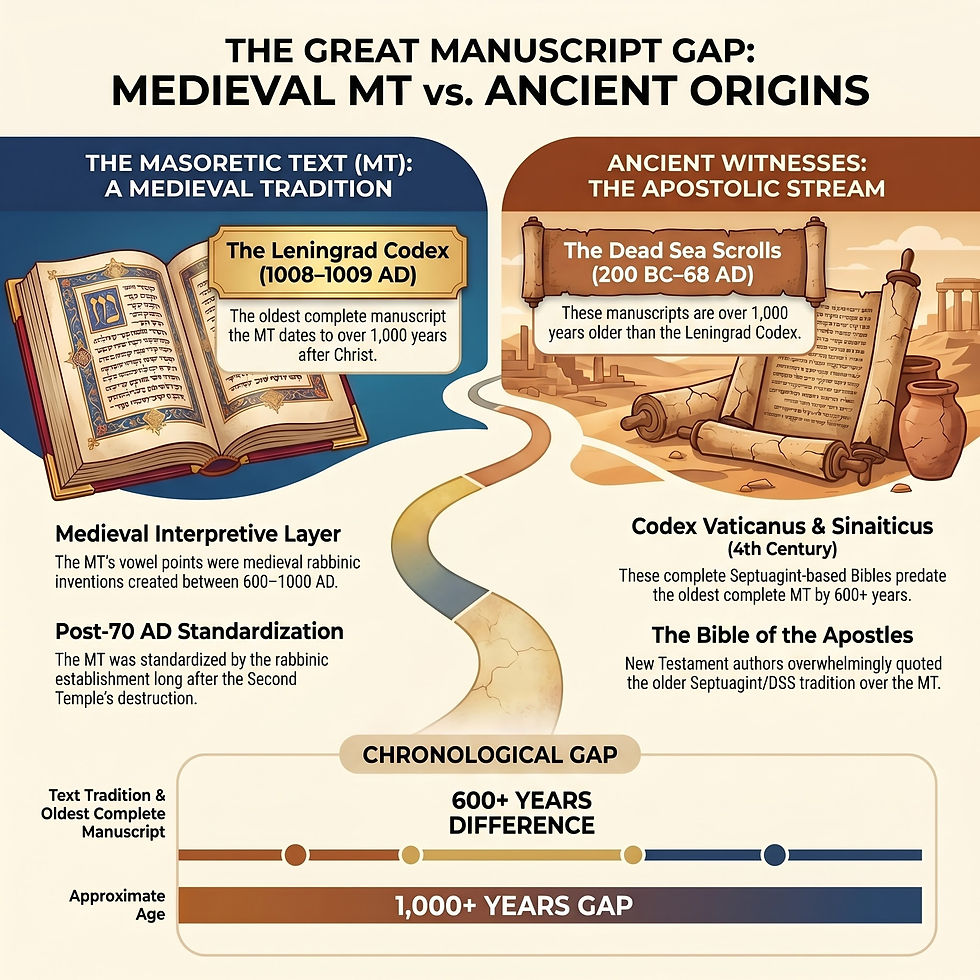
Masoretic Text (MT): The medieval Hebrew text, the base for most modern English Bibles (KJV, NIV, ESV). Its oldest complete manuscript, the Leningrad Codex, dates to 1008–1009 AD.
Samaritan Pentateuch (SP): An ancient, independent Hebrew witness of the Torah preserved outside the Judean/rabbinic firewall.
Rabbinic Judaism: The post-70 AD Jewish religious establishment that standardized the MT to counter the rise of early Christianity.
Deuterocanonical Texts: Foundational first-century texts (e.g., Sirach, 1 Enoch, Wisdom of Solomon) excised by the rabbinic establishment and later dropped by Protestant Reformers, severing the theological bridge between the Testaments.
Vorlage: The Hebrew source text from which a translation was made. When the LXX differs from the MT, it often reflects a genuinely different and older Vorlage, not a translator’s error.
Theoretical Framework & Historical Context
To understand textual divergences, one must recognize that pre-rabbinic Judaism was multi-textual. As established by Emanuel Tov and Frank Moore Cross, the Qumran discoveries reveal at least three coexisting textual families: the proto-MT (a regional Babylonian text), the proto-Samaritan text, and the Hebrew Vorlage of the LXX. The MT achieved dominance not through inherent textual superiority, but through institutional power following the catastrophic Bar Kokhba revolt (135 AD) and the destruction of the Second Temple (70 AD).

The archaeological record makes this timeline concrete and undeniable. The Dead Sea Scrolls from Qumran (approximately 200 BC–68 AD) show wild textual diversity, with proto-MT, proto-LXX, and proto-Samaritan texts all coexisting side by side. But the scrolls recovered from Wadi Murabba’at (dated to approximately 135 AD and associated with the post-Bar Kokhba period) show texts virtually identical to the MT. The standardization happened exactly when and why this paper argues it did. Someone didn’t just theorize that the rabbis standardized the text after 70 AD. The dirt proved it.
The single human figure most responsible for this standardization was Rabbi Akiva, the primary theological architect of the post-Bar Kokhba rabbinic reconstruction. Akiva declared Bar Kokhba the Messiah, oversaw the formal rejection of the LXX as authoritative Jewish scripture, championed Aquila’s aggressively anti-Christian Greek translation as its replacement, and was central to the canonization decisions at Jamnia (Yavneh). When this paper refers to the rabbinic establishment altering or standardizing the text, Akiva is the face of that project.
The Masoretes (the scribal guild responsible for the final form of the MT between approximately 600–1000 AD) inherited this standardized tradition and added an elaborate system of vowel points, accent marks, and marginal notes. This system is sophisticated and reflects genuine scholarly care. But it also reflects medieval rabbinic interpretive decisions, not ancient originals. Ancient Hebrew was written without vowels. The Masoretic vowel pointing system was invented over a thousand years after Christ. Every vowel in the MT is a medieval rabbinic choice. When a Protestant translator says "the Hebrew says X," they frequently mean "the medieval rabbis pointed the Hebrew to say X." The LXX translators worked from unpointed Hebrew centuries earlier, and their vowel choices often differ from the Masoretes, representing an older interpretive tradition that predates the rabbinic standardization entirely.
The Masoretes also acknowledged, implicitly, that they were working from damaged and conflicting manuscripts. The two foundational MT manuscripts (the Aleppo Codex and the Leningrad Codex) disagree with each other in thousands of places. If the MT were a pristine original, its two most important manuscripts would not contradict each other.
The Samaritan Schism: Judean Innovation vs. Samaritan Conservatism
The historical schism between Judeans and Samaritans is often read through Judean polemics (e.g., 2 Kings 17), which paint the Samaritans as syncretic pagans from "Cuthah." However, 2 Chronicles 30 notes Hezekiah inviting Israelites from Ephraim and Manasseh to Passover, proving a remnant remained. The Samaritans were fiercely monotheistic, indigenous descendants of the Northern Kingdom holding onto a conservative, agrarian Israelite faith.
The schism arose because returning Judean exiles brought back an imperial-backed, Babylonian-influenced religion. The Samaritans rejected these Judean innovations, which included:
The Expanded Canon: Samaritans rejected the Prophets and Writings as Judean political propaganda designed to legitimize the Davidic dynasty, retaining only the Torah.
The Alphabet War: Samaritans retained the ancient Paleo-Hebrew script, rejecting the Judean adoption of the Imperial Aramaic “square script” acquired in Babylon.
Sacred Time: Judeans adopted the Babylonian lunisolar calendar and pagan month names (Nisan, Tammuz). Samaritans maintained an agrarian observation calendar.
Worship Style: Judeans developed the text-based proto-synagogue in exile. Samaritans maintained the ancient, sacrificial agrarian cult on Mount Gerizim.
Purity Laws: Ezra weaponized a “Holy Seed” theology, enforcing mass divorce to consolidate power. The Samaritans rejected this racial purity in favor of strict, literal Levitical bodily purity.
Geographic Center: Samaritans argued Jerusalem is never mentioned in the Torah. They pointed strictly to Deuteronomy 11 and 27, locating the true sanctuary on Mount Gerizim. To the Samaritans, the "Eli Schism" during the period of the Judges (when Eli moved the sanctuary south to Shiloh) was the true breakaway cult that David and Solomon later inherited.
Evidence Domain I: Active Theological Engineering in the MT
The MT tradition is marked by calculated alterations designed to solve theological problems or neutralize Christian apologetics.
Internal Rabbinic Confessions
The rabbinic tradition itself admits to deliberate textual intervention:
Tiqqune Sopherim ("Corrections of the Scribes"): Rabbinic literature lists instances where scribes intentionally altered the text to avoid anthropomorphisms or disrespect toward God. In Genesis 18:22, the original "the LORD still stood before Abraham" was reversed to protect God’s honor. Similar changes occur in Numbers 11:15, Zechariah 2:8, and Malachi 1:13.
Itture Sopherim ("Omissions"): Acknowledged scribal deletions of specific conjunctions and particles.
The Kethiv-Qere Apparatus: The Masoretes flagged over 1,500 places where the written text (Kethiv) was deemed problematic, substituting an oral reading (Qere). This built-in system acknowledges pervasive textual uncertainty baked into the MT itself.
Chronological Compression and Messianic Timelines
Daniel 9 and the Seder Olam Rabbah: The 70 Weeks prophecy mathematically scheduled the Messiah’s arrival in the first century. In response, the rabbinic establishment officially adopted the Seder Olam Rabbah, a chronological system that compressed Persian history, effectively moving the calendrical goalposts to discredit Jesus as arriving at the wrong time.
Patriarchal Ages (Genesis 5 & 11): Scribes systematically subtracted exactly 100 years from the ages of multiple patriarchs at the birth of their sons. Archbishop Ussher’s 17th-century chronology uses the MT to date creation to approximately 4004 BC. The LXX and SP calculations yield a timeline roughly 1,300 years older. The MT was altered because a widespread first-century Jewish prophecy expected the Messiah in the "Sixth Millennium." The older LXX math placed Jesus exactly in that window. The MT scribes shrank the timeline to "prove" He arrived too early.

The Missing Cainan (Genesis 11 / Luke 3:36): The MT intentionally omits Cainan from the Genesis 11 genealogy. The LXX preserves him, as does Luke 3:36. The NT itself debunks the MT genealogy.
Anti-Christian and Theological Sanitization
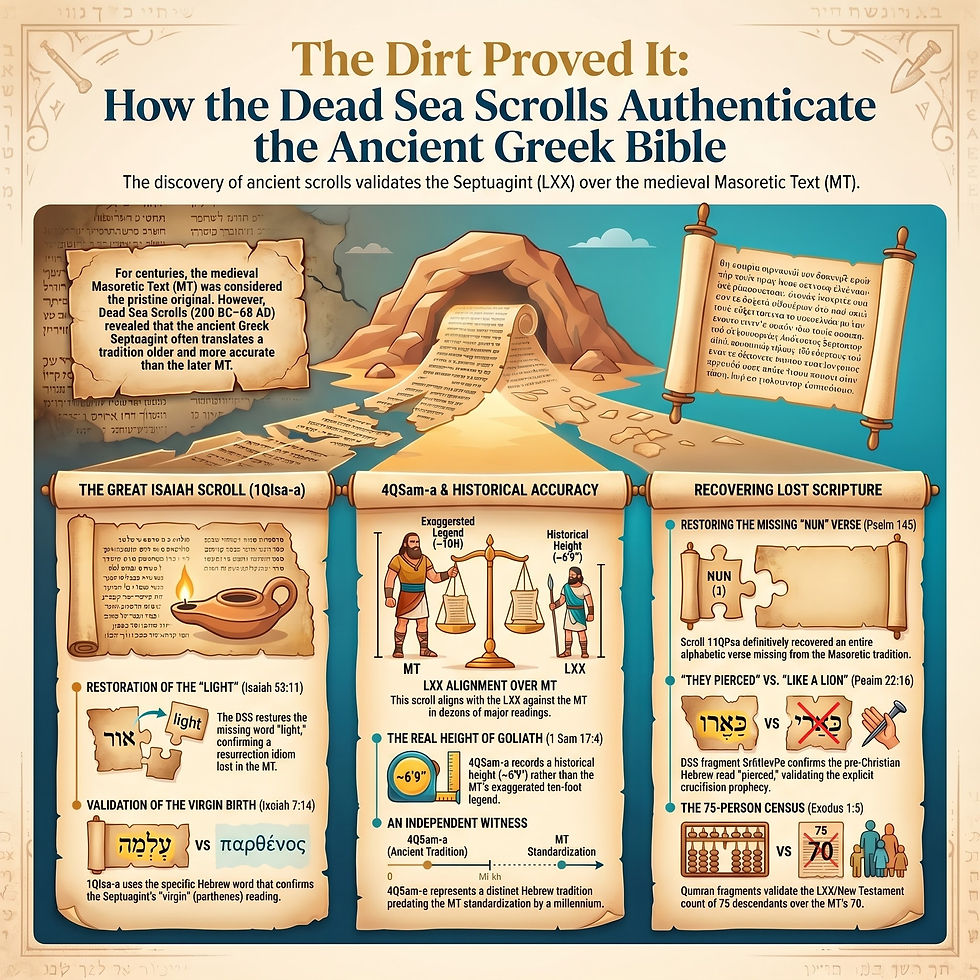
Isaiah 7:14 (The Virgin Birth): The LXX translated the Hebrew as parthenos (virgin) centuries before Christ. Later rabbinic authorities commissioned new Greek translations (Aquila, Theodotion, Symmachus) specifically to replace the LXX. Aquila (personally endorsed by Rabbi Akiva) deliberately reverted the word to neanis (young woman) to undermine Matthew 1:23. Jerome explicitly noted that Aquila strove "not so much to translate as to contradict." Notably, the Dead Sea Scrolls Isaiah scroll uses the same Hebrew word the LXX translated as parthenos, confirming the older reading.
Psalm 22:16 (The Crucifixion): The MT reads ka’ari ("like a lion are my hands and my feet"), which is grammatical nonsense in context. The LXX reads "they pierced." In 1999, the DSS fragment 5/6HevPs confirmed the pre-Christian Hebrew read ka’aru ("they pierced/dug"). This is either a devastating typo or a deliberate alteration of the single most explicit crucifixion proof-text in the entire Old Testament. This discovery deserves to be stated plainly: a pre-Christian Hebrew manuscript confirms the LXX reading of Psalm 22:16. The MT is the outlier.
Deuteronomy 32:8 (Divine Council): The MT reads God divided the nations according to the "sons of Israel" (bene Yisrael). The LXX and DSS (4QDeut-j) read "sons of God" (bene elohim). The MT sanitized the text to remove the ancient divine council worldview and neutralize early Christian claims of Christ as the supreme Son of God reclaiming the nations.
Deuteronomy 32:43 (Angels Worship the Son): The MT amputated the line commanding angels to worship the Son entirely. The LXX preserves it. The DSS (4QDeut-q) confirms the LXX reading in ancient Hebrew. The author of Hebrews quotes this line directly (Hebrews 1:6) as the foundation of his Christology. The MT doesn’t just differ here. It deleted a verse the NT treats as authoritative scripture.
Deuteronomy 27:4 (Gerizim vs. Ebal): For centuries, Protestants assumed Samaritans forged this verse to place the altar on Mount Gerizim instead of the MT’s Mount Ebal. However, DSS fragment 4Q41 and the Old Latin witness prove that Gerizim was the original reading. Judean scribes corrupted the MT out of sectarian hostility toward the Samaritans.
1 Samuel 1:11, 22 (Samuel’s Nazirite Vow): The DSS (4QSam-a), the LXX, and Sirach 46:13 explicitly record Hannah dedicating Samuel as a "Nazirite forever." The MTcompletely erased the word "Nazirite" to clean up the legal headache of an Ephraimite acting as a priest, protecting strict later Levitical boundary markers.
The Book of Esther: The MT entirely excised God from the book, leaving it seemingly secular. The LXX contains 107 additional verses, including desperate theological prayers. The MT stripped the theology so the scroll could be safely read at raucous Purim festivals without desecrating the Divine Name (a liturgical convenience that permanently altered the canonical text).
Habakkuk 2:4 (Faith vs. Faithfulness): The MT reads "The righteous shall live by his faith[fulness]," focusing on human law-keeping. The LXX reads "live by my faith" (God’s fidelity). Paul and Hebrews 10:38 rely entirely on the LXX to build the doctrine of Sola Fide. The Protestant doctrine of salvation by faith is built on the LXX, not the MT.
Numbers 24:7 (Gog vs. Agag): The MT replaces the eschatological enemy "Gog" (LXX) with the local historical king "Agag," taming a cosmic messianic victory into a local footnote.
Evidence Domain II: Passive Degradation in the MT
Beyond active alteration, the MT suffers from massive structural failures (accidental losses proving it is a degraded copy, not a pristine original).
Psalm 145 (The Missing Nun Verse): This alphabetical acrostic is missing the verse for the letter Nun in the MT due to haplography. The LXX preserves it ("The Lord is faithful in all his words…"), and the DSS (11QPsa) definitively validated the LXX reading in ancient Hebrew.
1 Samuel 13:1 (Saul’s Nonsensical Age): The literal MT reads: "Saul was one year old when he began to reign, and he reigned two years." This biological impossibility is a severe scribal corruption. English MT-based Bibles actively invent numbers (e.g., "thirty years") to hide this damage. The oldest LXX editions omit the verse entirely, recognizing it as corrupted marginalia. Modern translators are literally fabricating text to cover up MT failure.
Isaiah 53:11 (The Missing "Light"): The MT reads: "Out of the anguish of his soul he shall see and be satisfied," dropping the object of the verb entirely. The LXX and two DSS Isaiah scrolls (1QIsa-a and 1QIsa-b) preserve the missing word: "He shall see light." This resurrective idiom (seeing light after death) was accidentally lost in the MT transmission and silently omitted from most Protestant Bibles.
Genesis 4:8 (Cain and Abel’s Dialogue): The MT states Cain spoke to Abel but omits the dialogue entirely. The LXX and SP preserve the missing text: "Let us go out to the field." The MT preserved the introduction to a conversation and lost the conversation itself.
Genesis 2:2 (The “Finished” Problem): The MT implies God was still working on the seventh day. The LXX, SP, and Syriac logically correct this scribal slip, recording that He finished on the sixth day.
The Textual Chaos of Hosea: The MT of Hosea is notoriously corrupt throughout. In Hosea 6:5, the MT’s grammatically anomalous "your judgment" becomes "my judgment" in the LXX. Hosea 7:16 features obscure syntax, and Hosea 13:2 presents bizarre grammar regarding human sacrifice.
Jeremiah 10 (Dislocated Insertions): Verses 6–8 and 10 in the MT interrupt a polemic against idolatry with doxological material. The LXX (confirmed by 4QJer-b) omits these insertions entirely, reading coherently. The MT absorbed marginal notes into the body of the text.
Hapax Legomena and Superscriptions: The MT contains nonsensical anomalies like ha-harmonah in Amos 4:3. Psalm superscriptions contain obscure and contradictory terms, and conflicting attributions (e.g., Psalm 88) highlight ongoing MT textual breakdown.
Doublet Problems (2 Samuel 22 / Psalm 18): These identical poems differ in the MT, revealing internal corruption where one MT text degraded while the parallel survived.
The Ezekiel 36–37 Structural Dislocation: Papyrus 967 (one of the oldest LXX manuscripts) places Ezekiel 37 (the Valley of Dry Bones) before Ezekiel 36:23b–38 rather than after it. This is not a word-level variant but a structural difference, suggesting the MT and LXX preserve genuinely different editorial arrangements of the same material (further evidence that the MT is not a fixed, original text but one editorial tradition among several).
Evidence Domain III: Archaeological Confirmation via the Dead Sea Scrolls
Before the discovery of the Dead Sea Scrolls at Qumran, critics dismissed the LXX as a "loose paraphrase." The DSS definitively proved that the LXX was faithfully translating a genuine, ancient Hebrew text that the medieval rabbis later suppressed.
The Two Editions of Jeremiah: The MT of Jeremiah is one-eighth longer than the LXX. DSS fragments 4QJer-b and 4QJer-d perfectly match the shorter LXX, proving the LXX is the First Edition and the MT is a bloated, later Second Edition.
The 75-Person Census (Gen 46:27 / Ex 1:5): The MT forces the number of Jacob’s descendants to 70. The LXX consistently counts 75, a figure validated by Qumran fragments (4QExod-b, 4QGen-Exod-a) and quoted by Stephen in Acts 7:14. Critically, Stephen delivered this number before the Sanhedrin (the highest Jewish legal body in Jerusalem) and they did not correct him. The LXX reading was considered legitimate even by first-century Jerusalem Judaism.
Goliath’s Height (1 Sam 17:4): The MT exaggerates Goliath to nearly ten feet. The LXX and DSS (4QSam-a) list a sober historical height of roughly six feet, nine inches (four cubits and a span). The MT inflated the legend. The DSS and LXX preserved the history.
4QSam-a and the Samuel Tradition: The DSS manuscript 4QSam-a is one of the most important finds for this entire discussion. It agrees with the LXX against the MT in dozens of readings across the Samuel narrative, predates the MT standardization by over a millennium, and was analyzed by Frank Moore Cross as representing a genuinely distinct and ancient textual tradition. It is not a variant. It is a witness to a different, older Hebrew text.
A Fluid Canon (Psalm 151 and Reworked Pentateuch): The MT rigidly enforces a 150-Psalm canon. The DSS (11QPsa) revealed a beautiful Hebrew original of Psalm 151, previously dismissed as a Greek Hellenistic invention appended to the LXX. The DSS proved it was ancient Hebrew all along. Furthermore, DSS texts like the Reworked Pentateuch (4Q158) and the bilingual structure of Daniel prove that the concept of an inviolable, fixed MT canon is a post-Qumran rabbinic invention.
Evidence Domain IV: Apostolic and Early Church Witness
The early Church and the New Testament authors did not use the MT. They overwhelmingly relied on the LXX, and their deepest theological architectures collapse if forced to rely solely on the Masoretic Text.
The New Testament Authors
The Book of Hebrews: The entire Christology of Hebrews depends on the LXX. Hebrews 1:6 commands angels to worship Christ, quoting Deuteronomy 32:43 verbatim from the LXX (a line the MT actively amputated). Hebrews 2:7 quotes the LXX of Psalm 8:5 ("lower than the angels"), whereas the MT reads "lower than God." Hebrews 10:5 quotes Psalm 40:6 ("A body you have prepared for me"); the MT reads, "You have dug out my ears." The Christology of Hebrews does not exist in the MT. It exists in the LXX.
The Apostle Paul: In Galatians 3:16, Paul’s argument about the singular "seed" depends entirely on the LXX’s singular Greek sperma. In Romans 10:18, Paul quotes Psalm 19:4: "Their voice has gone out to all the earth." The MT reads "Their measuring line (qavam)." Paul did not allegorize a construction tool. He quoted the uncorrupted Hebrew (qolam, "their voice") preserved by the LXX. In Habakkuk 2:4, Paul’s entire doctrine of justification by faith rests on the LXX reading. The MT version supports law-keeping. The LXX version supports grace. Paul chose correctly.
The Apostle Peter: In 1 Peter 2:6, Peter quotes Isaiah 28:16 as the foundation for personal faith: "Whoever believes in him will not be put to shame." The MT reads impersonally: "He who believes will not be in haste." Peter’s theology of personal salvation requires the LXX’s personal pronoun.
James at the Jerusalem Council: In Acts 15:17, James justifies Gentile inclusion by quoting Amos 9 ("That the remnant of mankind may seek the Lord"). The MT reads "possess the remnant of Edom" (a nationalistic, militaristic reading). Because ancient Hebrew lacked written vowels, the MT scribes later added vowels that transformed a universal promise into an ethnic land claim. James read the older, universal text.
Jesus of Nazareth: Jesus consistently utilized the LXX against the Judean establishment.
Mark 7:6–7 (Isaiah 29:13): Jesus condemns the Pharisees: "In vain do they worship me, teaching as doctrines the commandments of men." The MT softens the blow, erasing the phrase "in vain." Jesus’s legal indictment of the Pharisees requires the LXX.
Matthew 21:16 (Psalm 8:2): Defending children in the temple, Jesus quotes: "You have prepared praise." The MT reads "established strength." The MT reading would have rendered Jesus’s defense of vocal worship nonsensical.
Luke 4:18 (Isaiah 61:1): Jesus launches His public ministry reading "recovery of sight to the blind." The MT completely erases this specific miracle. Jesus was not misquoting. The MT lost the messianic marker.
Lost Vowels (Genesis 47:31 vs. Hebrews 11:21): Hebrews states Jacob bowed on the head of his staff. The MT says bed. The unpointed Hebrew consonants (M-T-H) weretranslated in the LXX as matteh (staff). Centuries later, the Masoretes pointed it as mittah (bed). The NT directly debunks the idea that MT vowel points are divinely inspired.
A Triumphant Taunt (Hosea 13:14 vs. 1 Corinthians 15:55): Paul’s resurrection climax ("O death, where is your sting?") is drawn directly from the LXX. The MT reads contextually as God announcing His own plagues ("I shall be your plagues, O death"). Paul’s entire resurrection taunt requires the LXX.
Hostile and Patristic Witnesses
Philo of Alexandria (c. 20 BC–50 AD) treated the LXX as divinely inspired scripture, representing a Hebrew text over a thousand years older than the MT’s Aleppo Codex.
Justin Martyr explicitly accused post-70 AD Jewish scribes of altering scriptures to obscure Christ (Dialogue with Trypho). He was not speculating. He was documenting changes he could see with his own eyes by comparing texts.
Origen’s Hexapla (c. 240 AD) thoroughly documented the divergence between the LXX and the proto-MT, proving these differences were systemic and historical. Critically, Origen’s project assumed the LXX was authoritative and used asterisks and obeli to mark where the MT had added or removed material relative to the LXX (treating MT additions as secondary intrusions, not original readings).
Jerome translated the Latin Vulgate from the Hebrew rather than the LXX, coining the phrase Hebraica Veritas (the Hebrew truth), a decision with enormous downstream consequences for Western Christianity and eventually Protestant translation. But Jerome himself had serious doubts. He acknowledged the LXX’s antiquity and authority, and was sharply criticized by Augustine, who warned Jerome in writing that abandoning the LXX would split the Church between Latin and Greek congregations. Augustine was right. It eventually did. The man most responsible for the West’s drift toward the MT knew it was controversial and potentially wrong.
The LXX Was Abandoned by Jews Because Christians Used It. This point deserves to be stated as plainly as possible. The early Church’s enthusiastic adoption of the LXX as their Old Testament is precisely why rabbinic Judaism distanced itself from it. The LXX didn’t become suspect because it was inaccurate. It became suspect because it was too useful to Christians. Aquila’s hyper-literal, anti-Christian Greek translation was commissioned as a replacement specifically because the LXX kept producing Christian proof-texts. That is a backhanded confirmation of the LXX’s messianic content.
The Peshitta (an independent Syriac translation from the Hebrew) frequently aligns with the LXX against the MT, further corroborating the LXX’s older Hebrew Vorlage.
The Kaige Recension (a Greek revision of the LXX toward the proto-MT, produced approximately in the first century BC through first century AD and documented by Barthélemy) demonstrates that Jewish scholars were actively revising the Greek toward a proto-MT standard before and during the NT period. This is direct, documented evidence of the standardization process in action. It was not a passive development. It was a project.
The Deuterocanon: The Severed Bridge
The removal of the Deuterocanonical texts from the Protestant Bible did not merely trim the canon. It severed the theological connective tissue between the Testaments and made the New Testament significantly harder to understand.
1 and 2 Maccabees provide the historical context for Hanukkah, the Feast of Dedication that Jesus celebrated in John 10:22. Protestant Bibles omit the books that explain the holiday Jesus attended.
Wisdom of Solomon contains passages that read almost like pre-Christian Logos theology and directly influenced the prologue of John’s Gospel.
Sirach (Ecclesiasticus) is quoted or alluded to throughout the NT and explicitly quotes the Nazirite tradition of Samuel (Sirach 46:13) that the MT erased.
1 Enoch is directly quoted by Jude 14–15 as prophecy: "Enoch, the seventh from Adam, prophesied…" Jude treats 1 Enoch as scripture. The Protestant canon excludes the book Jude quotes as authoritative prophecy.
The rabbinic establishment excluded these texts after 70 AD. Protestant Reformers, deferring to the rabbinic canon, followed suit. The result is a Bible that quotes books it doesn’t contain and references theological frameworks it has removed.
Discussion: Reframing Protestant Hermeneutics and the New Testament
Defaulting to the Masoretic Text traps modern English translators and Protestant exegetes into theological gymnastics. To hide MT brokenness, translators frequently invent numbers (1 Sam 13:1), quietly insert words (Isa 53:11), or assume the Apostles were carelessly "spiritualizing" the text. Acknowledging the LXX as the premier textual witness restores the Apostles as precise, master theologians quoting the Bible of the first-century world.
Furthermore, integrating the Samaritan witness upends standard readings of New Testament narratives. Jesus’s interaction with the Samaritan Woman at the Well (John 4) is not a dialogue with a syncretic pagan, but an engagement with the indigenous Northern Kingdom. Because she held only to the uncorrupted Torah, she did not look for a Davidic King, but for the Taheb (the Prophet like Moses from Deuteronomy 18:15), a theological framework Jesus and the early Church (Acts 3, Acts 7) explicitly validated.
The parable of the Good Samaritan is not a simple fable about racial harmony. It is a devastating theological critique of MT-based religion. The priest and Levite pass by on the other side (almost certainly because touching a corpse would render them ritually impure under Levitical law). They are not simply callous. They are following the rules of the MT tradition. Jesus then takes a man whose entire religious framework the Jerusalem establishment considered heretical (someone who rejected the Temple, the Davidic dynasty, the expanded canon, and the MT tradition) and declares that he understands the heart of the Torah better than the highest religious officials of the MT establishment. The parable is not about kindness. It is about which textual tradition actually produces righteousness.
The oldest complete Bibles in existence (Codex Vaticanus and Codex Sinaiticus, both dating to the 4th century AD) contain the LXX Old Testament, not a Hebrew or MT-based text. These manuscripts are older than any complete MT manuscript by over 600 years. The oldest complete MT manuscript (the Leningrad Codex) dates to 1008–1009 AD. When someone asks which Bible is older, the answer is unambiguous. The LXX-based manuscripts predate the MT’s oldest complete witness by more than six centuries.
Conclusion
The evidence assembled across textual, archaeological, historical, and linguistic domains presents a consistent and damning picture: the Masoretic Text is a curated, late text that suffered from accidental scribal degradation and active polemical sanitization. Its claim to exclusive canonical authority is historically unjustified and textually unsupportable.
The standardization of the MT was a post-70 AD institutional project, archaeologically confirmed by the contrast between the pluriform Qumran texts and the rigid uniformity of the post-Bar Kokhba Wadi Murabba’at scrolls. Its vowel points are medieval inventions. Its two most authoritative manuscripts contradict each other. Its scribes admitted to deliberate alterations. Its most important readings are contradicted by the Dead Sea Scrolls. And the New Testament authors (from Jesus to Paul to the author of Hebrews) quote a text that frequently does not exist in the MT at all.
Conversely, the Septuagint and the Samaritan Pentateuch preserve ancient, expansive, and highly accurate Hebrew traditions. Validated by the Dead Sea Scrolls and overwhelmingly endorsed by the New Testament authors, the LXX is not merely a Greek translation. It is a divinely preserved textual stream representing a Hebrew tradition older, broader, and more theologically intact than anything the Masoretes produced. It is the Bible of the Apostles. It is the Bible of the Eastern Orthodox Church. It is the Bible the oldest surviving Christian manuscripts contain.
Any intellectually honest assessment must recognize that to read the Bible as the Apostles read it, one must look beyond the Masoretic consensus (not as a radical act, but as a return to what the Church always had before the Protestant Reformation handed its Old Testament to a medieval rabbinic tradition).
References
Andersen, F., & Freedman, D. N. (1980). Hosea. Anchor Bible. Doubleday.
Attridge, H. (1989). The Epistle to the Hebrews. Hermeneia. Fortress Press.
Barthélemy, D. (1963). Les Devanciers d’Aquila. Brill.
Barthélemy, D. (1982–2015). Critique Textuelle de l’Ancien Testament. 5 vols. Vandenhoeck & Ruprecht.
Beale, G. K. (1999). The Book of Revelation. NIGTC. Eerdmans.
Crawford, S. W. (2008). Rewriting Scripture in Second Temple Times. Eerdmans.
Cross, F. M. (1953). "A New Qumran Biblical Fragment Related to the Original
Hebrew Underlying the Septuagint." Bulletin of the American Schools of Oriental Research, 132, 15–26.
Cross, F. M. (1964). "The History of the Biblical Text in the Light of Discoveries in the Judean Desert." Harvard Theological Review, 57, 281–299.
Dahood, M. (1966–1970). Psalms. 3 vols. Anchor Bible. Doubleday.
Fernández Marcos, N. (2000). The Septuagint in Context. Brill.
Flint, P. (1997). The Dead Sea Psalms Scrolls and the Book of Psalms. Brill.
Ginsburg, C. D. (1897). Introduction to the Massoretico-Critical Edition of the Hebrew Bible. Trinitarian Bible Society.
Grafton, A., & Williams, M. (2006). Christianity and the Transformation of the Book. Harvard University Press.
Hays, R. (1989). Echoes of Scripture in the Letters of Paul. Yale University Press.
Heiser, M. (2001). "Deuteronomy 32:8 and the Sons of God." Bibliotheca Sacra, 158, 52–74.
Heiser, M. (2015). The Unseen Realm. Lexham Press.
Honigman, S. (2003). The Septuagint and Homeric Scholarship in Alexandria. Routledge.
Jobes, K., & Silva, M. (2000). Invitation to the Septuagint. Baker Academic.
Klein, R. (2006). 1 Chronicles. Hermeneia. Fortress Press.
Lust, J. (1981). "Ezekiel 36–40 in the Oldest Greek Manuscript." Catholic Biblical Quarterly, 43, 517–533.
McCarter, P. K., Jr. (1984). II Samuel. Anchor Bible. Doubleday.
McKane, W. (1986–1996). Jeremiah. 2 vols. International Critical Commentary. T&T Clark.
McLay, R. T. (2003). The Use of the Septuagint in New Testament Research. Eerdmans.
Milik, J. T. (1961). Les Grottes de Murabba’ât. Clarendon Press.
Runia, D. (1993). Philo in Early Christian Literature. Fortress Press.
Stern, S. (2001). Calendar and Community. Oxford University Press.
Tov, E. (2011). Textual Criticism of the Hebrew Bible (3rd ed.). Fortress Press.
Ulrich, E. (1999). The Dead Sea Scrolls and the Origins of the Bible. Eerdmans.
VanderKam, J. (2010). The Dead Sea Scrolls Today (2nd ed.). Eerdmans.
Weitzman, M. (1999). The Syriac Version of the Old Testament. Cambridge University Press.
Würthwein, E. (1995). The Text of the Old Testament (2nd ed.). Eerdmans.
Yadin, Y. (1983). The Temple Scroll. 3 vols. Israel Exploration Society.
Yeivin, I. (1980). Introduction to the Tiberian Masorah. Scholars Press.


Comments